Commissioning as a discipline
Commissioning is where the gap between design intent and operational reality gets closed. It is where incorrect wiring gets found, where control logic meets real instrumentation for the first time, and where the assumptions built into a program get tested against the process they were designed to control.
Done properly, commissioning produces a system that operations can take ownership of confidently, with documentation that reflects what’s actually installed. Done poorly - rushed, undocumented, or compressed into whatever time is left after construction overruns - it produces a system that nobody fully trusts and a maintenance team that has to rediscover how it works every time something goes wrong.
We treat commissioning as engineering work, not as a final site visit.
What commissioning support covers
Factory acceptance testing (FAT) - testing of PLC programs, HMI screens, and control panels in a workshop environment before site delivery. Using simulated I/O to verify control sequences against the functional specification. Punch lists raised and closed before equipment leaves the factory. FAT done properly reduces site commissioning time significantly.
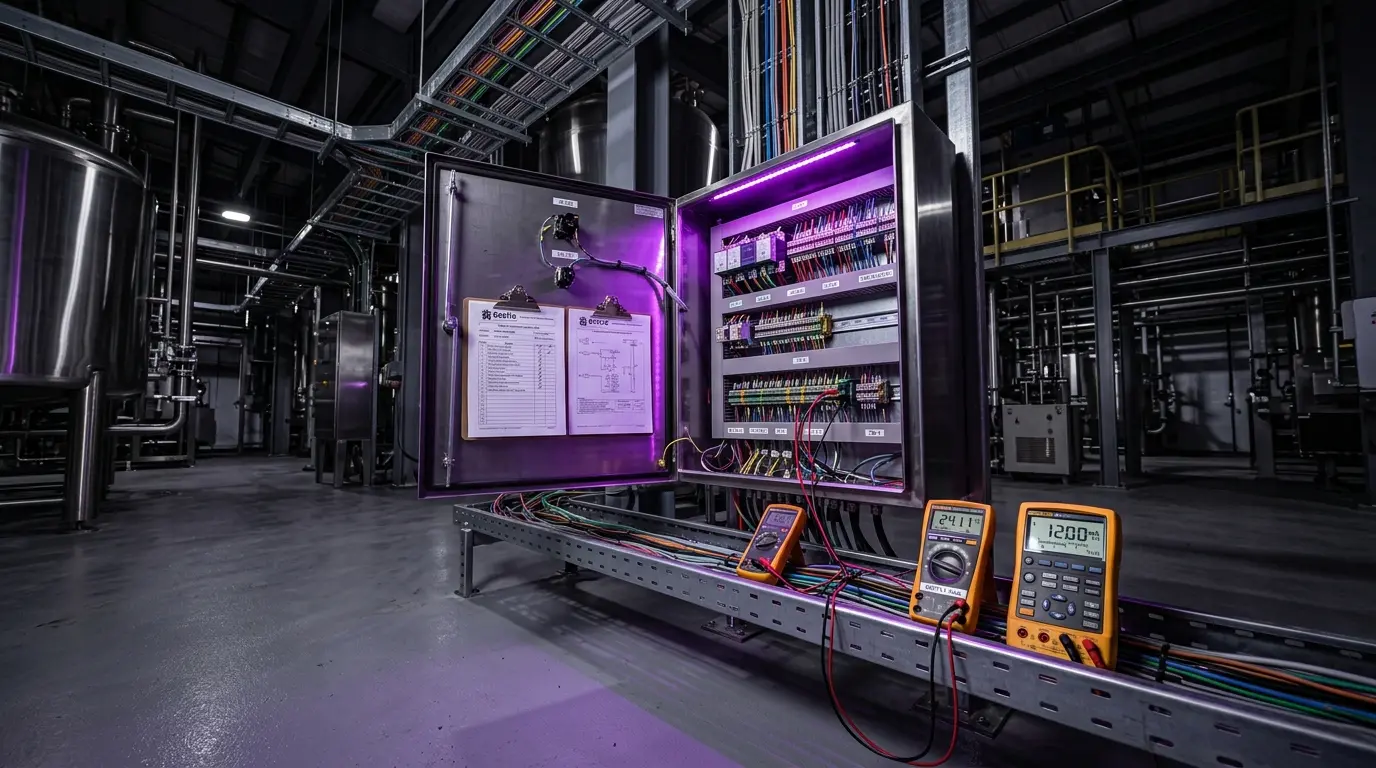
Pre-commissioning checks - systematic verification of installed wiring against drawings, panel inspection, instrument installation checks, and power-on verification of hardware before any process is started. Finding wiring errors at pre-commissioning is far less disruptive than finding them during startup.
Loop checking - end-to-end testing of each instrument loop from field device through to control system display. Verifying signal types, ranges, scaling, engineering units, and alarm setpoints. Documented on loop check sheets, one per loop.
Functional testing - testing of each control sequence, interlock, and alarm against the functional specification or cause and effect matrix. Sequences stepped through manually to verify correct behaviour before automatic operation. Failures recorded and tracked to resolution.
Startup support - engineering presence during initial startup of the process. Supporting operations during first run, monitoring control system behaviour against expectations, and responding quickly to issues as they appear. The first few hours of a new system running are when the remaining gaps between simulation and reality show up.
Operator handover - structured walkthrough of the control system with operations during or after startup. Not a formal training course - a working session where operators run the system with engineering support available. The goal is that operations leave the handover confident in what the system does and how to manage it.
As-built documentation - updating drawings, I/O lists, and program documentation to reflect the installed and commissioned state. Issued as a final package at project close.
Working within outage constraints
Commissioning on operating plants is always constrained by the available outage time. We plan commissioning sequences to make the most of the time available - identifying what can be pre-commissioned on live plant before the shutdown, and sequencing the shutdown work to get the highest-risk activities done first.
We work well under time pressure because we prepare thoroughly before the shutdown starts. Commissioning documentation templates are prepared in advance, the test sequence is agreed with the project team, and pre-commissioning work is completed before the outage window opens.