Getting plant data to where it needs to go
Industrial facilities generate enormous amounts of operational data. Equipment runtimes, process values, energy consumption, fault histories - most of it lives in PLCs and local historians that business systems can’t easily reach. Management wants production dashboards. Maintenance wants equipment health trends. Engineering wants fault data for root cause analysis.
Industrial IoT is the engineering discipline of moving that data reliably from plant floor to where it’s useful - cloud platforms, business dashboards, maintenance systems, or remote monitoring tools - while keeping the control systems that produce it safe and unaffected.
What we build
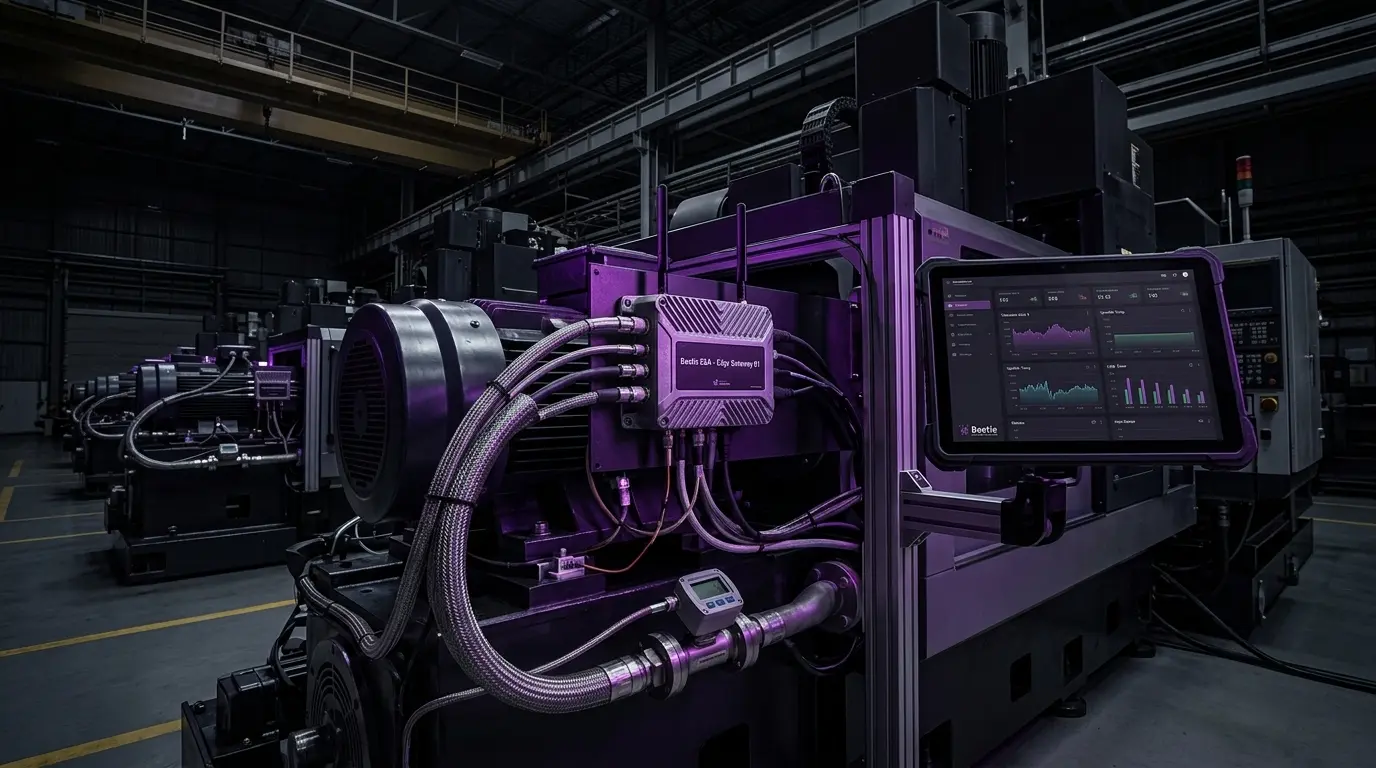
Edge data collection - edge computing devices installed on the plant network that read data from existing PLCs, instruments, and equipment using standard protocols. No modification to the control system required. The edge device collects, buffers, and forwards data to upstream systems, handling connectivity outages gracefully so data is not lost during network interruptions.
Cloud connectivity - secure, outbound-only connections from edge devices to cloud IoT platforms. AWS IoT Core, Azure IoT Hub, and Ignition MQTT are our primary platforms. Data is structured, timestamped, and delivered to the cloud in formats that analytics and reporting tools can consume.
Remote monitoring dashboards - cloud-hosted or on-premises dashboards giving management, engineering, and maintenance teams visibility of plant performance from anywhere. Production KPIs, equipment status, energy consumption, and alarm summaries formatted for the audience - not raw process data.
Equipment health monitoring - tracking runtime hours, cycle counts, vibration trends, and other condition indicators for critical equipment. Early warning of developing faults before they become unplanned stoppages. Configured around the equipment that matters most to your operation.
Energy monitoring - metering and monitoring of electrical energy consumption at equipment, area, or facility level. Data used for energy reporting, cost allocation, and identifying optimisation opportunities. Increasingly relevant as energy costs rise and carbon reporting requirements grow.
On-premises alternatives - for operations where public cloud is not suitable due to data sovereignty, connectivity constraints, or IT policy, we deploy equivalent capability on local or private infrastructure. Ignition-based solutions in particular work well in on-premises configurations.
How we approach IIoT projects
We start by understanding what decisions the data needs to support. A production dashboard for the general manager needs different data and different presentation to a fault trend dashboard for the maintenance team. Getting that clear before building anything avoids the common outcome of a system that collects a lot of data nobody uses.
From there we identify what data already exists in your control systems, what additional sensing is needed, and how the data pathway from plant floor to end user should be structured. We design the edge architecture, configure the cloud connectivity, build the dashboards, and test end-to-end before handover.
IIoT integration framework experience
In 2020, Dennis developed IIoT integration frameworks for two Australian sensor technology companies covering the practical engineering required to connect emerging IIoT sensor hardware into existing PLC and SCADA environments.
2Censor (Mackay) - integration framework for 2Censor’s asset wear sensor platform, covering protocol conversion options between the sensor data stream and industrial control systems, security architecture for introducing IIoT devices into OT networks, and practical integration paths using Kepware OPC server, Node-RED, and OPC-UA. 2Censor’s sensors are used for wear monitoring on industrial equipment in mining and processing environments.
Vayeron Smart-Idler (Koodaideri Mine, Rio Tinto) - integration framework for Vayeron’s Smart-Idler conveyor belt idler monitoring sensors, developed in the context of the Rio Tinto Koodaideri iron ore project. The framework covered Kepware driver configuration for sensor data acquisition, Node-RED for data transformation and routing, OPC-UA for integration into the site SCADA platform, and security considerations for deploying IIoT devices on a critical conveyor system.
Both frameworks addressed the core IIoT integration challenge - novel sensor hardware with proprietary or non-standard communications needs to be connected to established industrial control platforms without introducing security risk or operational complexity. Kepware, Node-RED, and OPC-UA remain the practical toolchain for this class of integration work.
Working within OT constraints
IIoT projects that ignore OT constraints cause problems. Devices that require inbound firewall rules, implementations that put engineering workstations on cloud networks, or dashboards that create pressure to add remote control capability incrementally - these are common failure modes.
We design IIoT solutions within the constraints of the OT environment from the start. Control systems stay on the control network. Cloud connections are outbound only. Edge devices are isolated from critical systems. The result is a monitoring capability that operations and IT can both support confidently.