When production stops
A fault that stops production is not an engineering problem - it is a business problem with an engineering solution. The priority is restoring operation safely, as quickly as possible, without making things worse.
We understand the pressure of a stopped plant. We work systematically and communicate clearly through a fault investigation - what we know, what we are checking, what the likely cause is, and what we need to restore operation. No guessing out loud, no unexplained delays.
How we approach fault finding
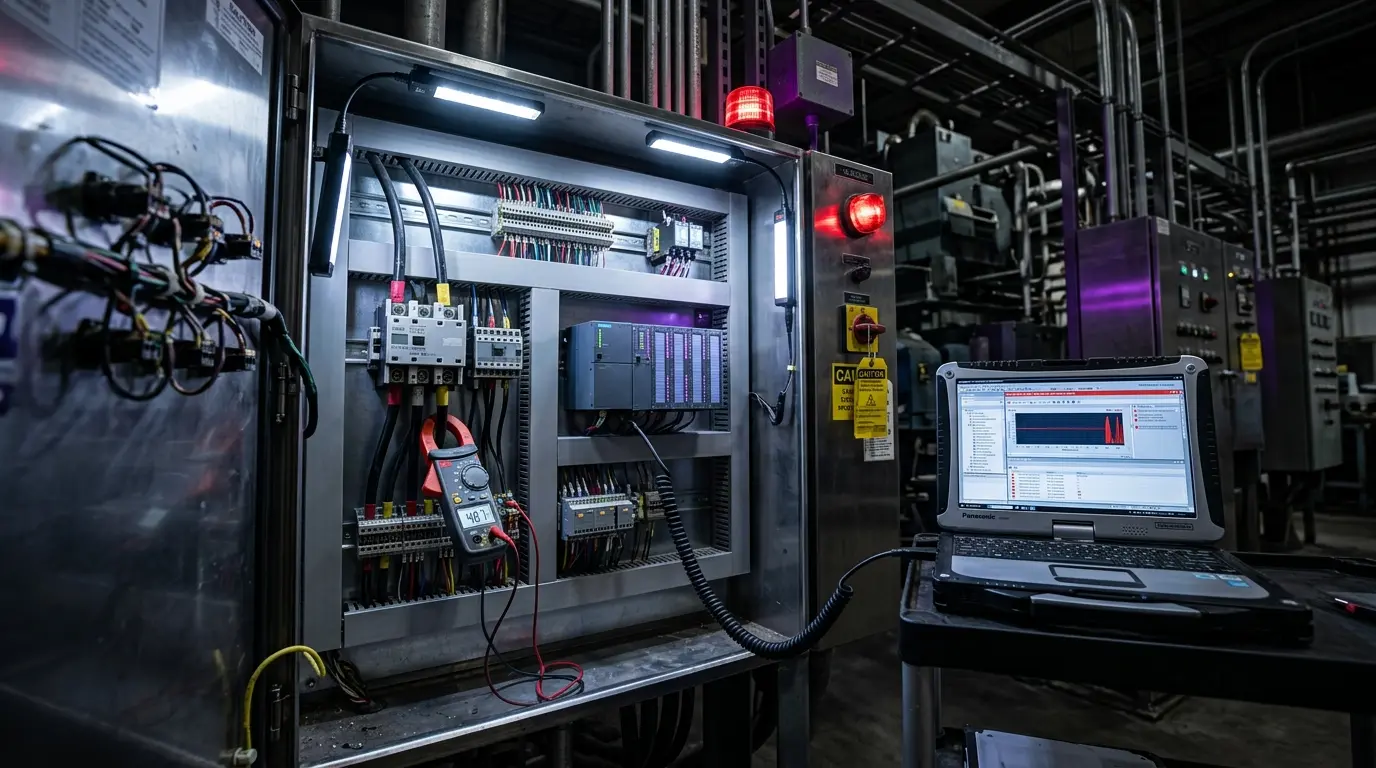
Good fault finding is methodical. It starts with understanding what the system was doing when it failed, what changed before the fault, and what the fault symptoms actually are - not what someone thinks they are. Then it works through the evidence: alarm histories, event logs, trend data, physical inspection, and systematic testing.
We do not swap parts hoping something fixes it. We diagnose first, then act. This approach takes a little longer at the start but avoids the situation where you have replaced three components and the fault is still present.
What we cover
PLC and control system faults - program faults, I/O failures, communication errors, sequence issues, and interlock problems. We read PLC programs, review alarm and event logs, and work through the logic to identify where the system has departed from expected behaviour.
SCADA and HMI faults - application faults, communication failures, database corruption, and display issues. Including faults where the SCADA is showing incorrect data but the control system is functioning correctly - a common source of confusion that requires checking the whole data path from field device to screen.
Electrical faults - switchgear faults, motor and drive problems, instrument failures, cable faults, and protection relay operations. We work on both LV and HV systems and can carry out electrical testing and insulation resistance measurement as part of a fault investigation.
Instrumentation faults - transmitter failures, calibration errors, loop faults, and signal integrity problems. End-to-end loop testing from field device through to control system.
Communication and network faults - lost communications between PLCs, between PLC and SCADA, or between control systems and field devices. Network troubleshooting including switch configuration, cable testing, and protocol-level diagnosis.
Post-trip investigations - systematic investigation of protection relay operations, unexpected shutdowns, and emergency stop events. Establishing whether the trip was correct and caused by a genuine fault, or spurious and caused by a system problem.
Remote support
For systems with secure remote access, we can connect to your control system from our office and carry out diagnosis without attending site. Remote diagnosis is faster to initiate, can happen outside business hours, and is often sufficient to resolve the fault or to give site personnel clear instructions for what to check or change.
Where site attendance is needed, remote diagnosis first means we arrive with a good understanding of the fault rather than starting from scratch on arrival.
After the fault is resolved
For significant faults we provide a written summary - what was found, what was done, the root cause, and any recommendations. If the fault points to a systemic issue - a failing piece of hardware that is likely to fail again, a control logic problem that creates recurring nuisance trips, or a maintenance practice that is accelerating equipment wear - we say so clearly, with a recommendation for how to address it.