HMI design that supports operations
The purpose of an HMI is to give an operator the information they need to make good decisions quickly. A screen that is cluttered, uses colour inconsistently, or buries critical information in submenus is worse than a well-organised paper-based system.
We design HMIs with the operator’s job in mind - what are they monitoring, what do they need to act on, and how quickly do they need to find it. That shapes screen layout, alarm presentation, navigation structure, and the level of detail on each display.
What we develop
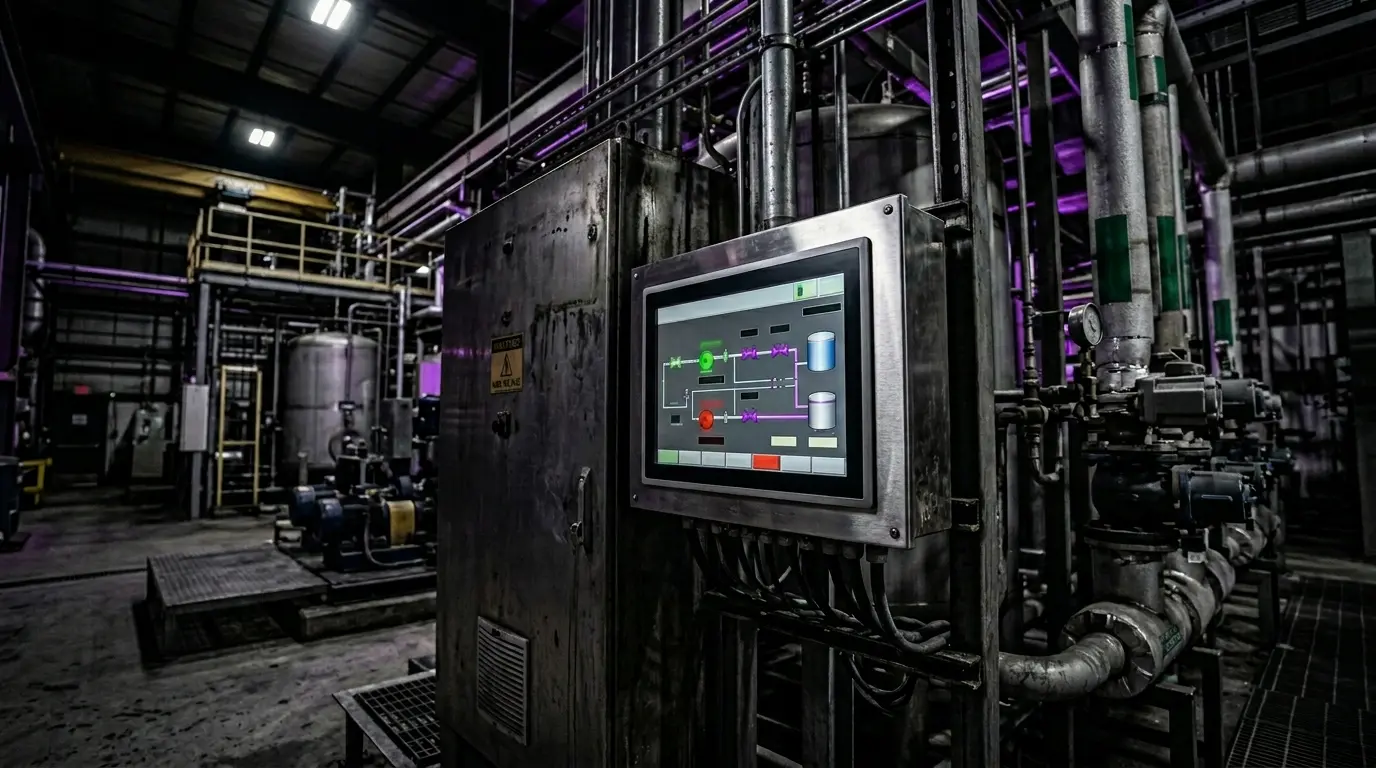
Panel HMIs - standalone touchscreen HMIs mounted on control panels or machine enclosures. Typically Rockwell PanelView or Emerson QuickPanel+ hardware. Used for local control and monitoring of a machine or process area. We develop the screen application, configure PLC communications, and commission on site.
PC-based operator stations - full operator workstation HMIs for control rooms and supervisor stations. AVEVA InTouch and Ignition are our primary platforms for this application. Includes multi-screen layouts, process overviews, area detail screens, alarm management displays, and trend views.
High-performance HMI redesigns - existing HMI screens redesigned to ISA-101 high-performance principles. Replacing the legacy bright-colour aesthetic with a design that uses colour purposefully - grey backgrounds, muted process states, and colour reserved for abnormal conditions and alarms. The result is a screen that operators can read faster and with less cognitive load.
Mobile and web-based HMI - responsive HMI screens built in Ignition Perspective that work on tablets, phones, and standard browsers. Useful for supervisor monitoring, remote access from the control room office, or mobile operators covering large plant areas.
Alarm management - alarm database design, priority assignment, and suppression logic as part of HMI development. Poorly configured alarms are one of the most common usability problems on industrial HMIs and one of the most fixable.
Our design approach
We start with a conversation about how operators actually use the system - not just what the process does, but how shifts run, what the common fault conditions are, and where operators currently have to work around the existing interface.
Screen layouts are reviewed with operations before build where possible. Iteration at the design stage is far cheaper than iteration after commissioning. We produce screen mockups for review, build to the approved design, and conduct a structured walkthrough before sign-off.
Platforms
Rockwell PanelView and FactoryTalk View ME for panel and distributed HMI applications in Allen-Bradley control systems. Emerson Proficy iFIX and QuickPanel+ for Emerson-based systems. AVEVA InTouch for larger operator station applications. Ignition Perspective where web-based clients, mobile access, or licensing flexibility are priorities. We recommend the platform that fits the project, not the one we happen to sell.